What makes a photograph truly artistic?

Introduction
At a time when billions of images circulate every day, one question remains essential: what distinguishes an artistic photograph from a simple image ? What makes a photo original, or at least, what sets it apart from the overly formatted photographs that circulate everywhere? Why do some photos move us or pique our interest, while others remain invisible and provoke only indifference?
Understanding the artistic value of a photograph involves exploring three dimensions:
the photographer's gaze ,
the artistic intention ,
the viewer's reception .

As a photographer-author, this question guides my approach: to reveal, even in the most modest subjects, what the eye does not see, and to make the ordinary less ordinary from an artistic perspective.
I. The gaze: the source of photographic originality
1. Seeing differently: the basis of all original photography
Today, everyone knows how to take a "beautiful" or "nice" picture. Taking a pretty photo is within everyone's reach. And with smartphones, everything is made easier and more immediate.
But an original photograph is born from something else: a singular vision , which will be expressed through an unusual composition, a particular use of light, or the photographer's ability to convey something that doesn't materially exist in the image. The photographer's skill in creating a special atmosphere also plays a significant role in the impression left by the photograph.

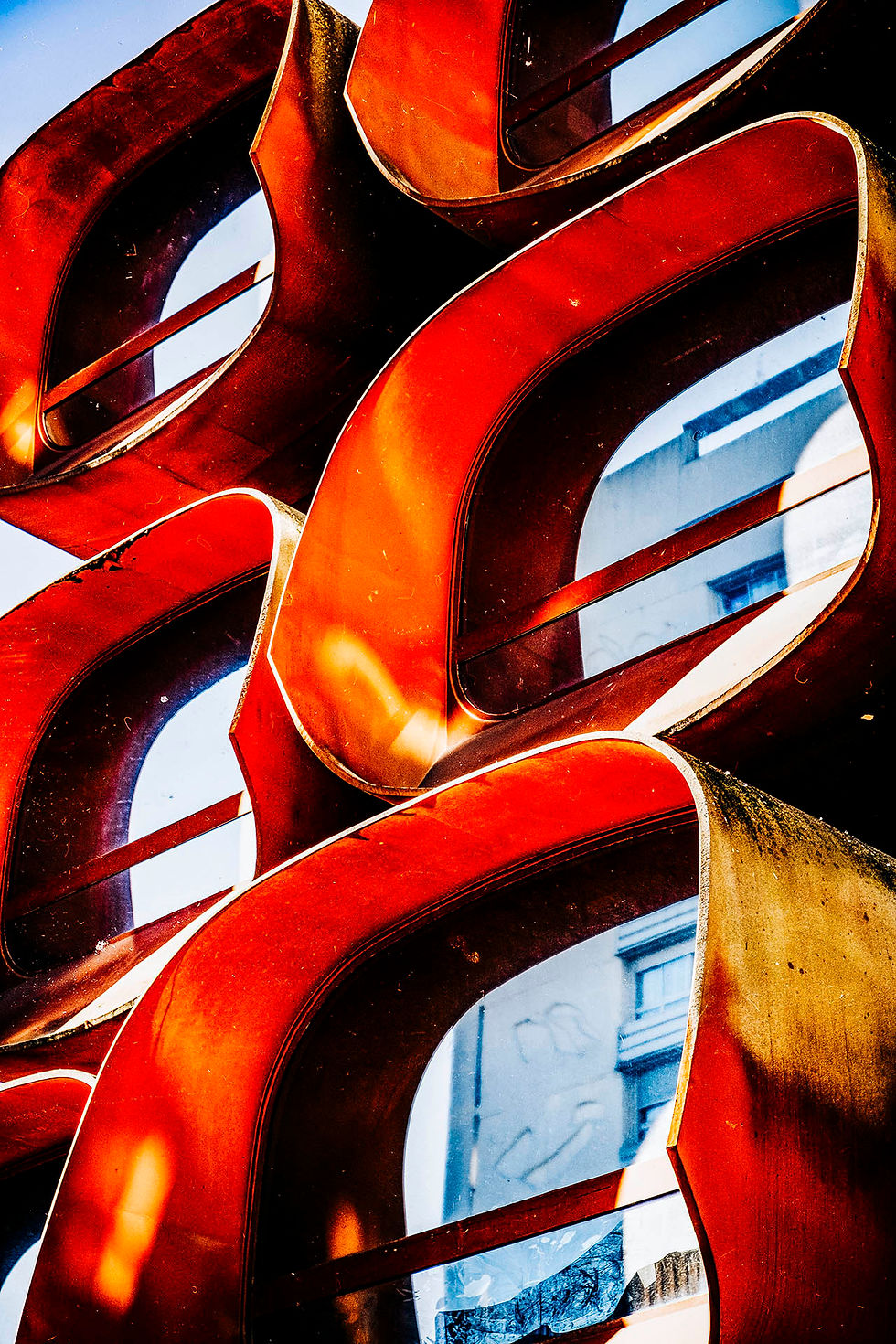
In my series on architecture and urbanism, I seek precisely this: to bring out the poetry of the ordinary , the minimalist forms scattered throughout the city, on a wall, a door, or even in the detail of a vintage car. For me, there is no such thing as a small subject in photography .
2. The eye of the photographer-author
Although as a photographer-author I maintain a documentary perspective on the world around me, I interpret more than I illustrate . I consider myself a subjective witness to urban life.
It is not the subject that makes the work, but the gaze that transforms it. This gaze is a particular way of looking at the world that blends attentiveness, sensitivity, and exacting standards, transfiguring a mundane reality into a more artistic photograph. The photographer-author reveals, through their gaze, a more compelling alternative reality.

II. Artistic intention: what transforms a photograph into a work of art
1. Intention as the driving force of artistic value
A photograph can be technically flawless yet remain empty. The image is pretty, even beautiful at times, but it expresses nothing more than technical qualities, whether they come from the photographer or the equipment he uses.
Conversely, a simple image can become an art photograph if it expresses a clear intention .
The intention is:
a perspective on a reality that is sometimes mundane or underlying, without necessarily explaining everything with a complicated concept,
a sensitivity unique to the photographer, and that is why we speak of a photographer-author and not simply a technician, however competent he may be.
a question posed to the viewer and an invitation to observe by directing their gaze.
a visual "message".

2. Consistency in serial work
In my work, whether minimalist or focused on the raw forms of the city, the intention always returns: to create calm visual spaces in a world saturated with images and which invite a form of contemplative reflection.
An artistic photograph is also recognized by its place within a coherent whole. For while a single photograph must be self-sufficient and exist autonomously, it is also part of a visual story, even more so in the case of a photographic series. I cannot conceive of my work outside of visual storytelling . I am an avid reader and I think of my photographic series as little visual novels .
III. Reception: when a photograph truly touches a viewer
1. Why do some images move us?
A photograph becomes a work of art when it resonates with the viewer and a dialogue is established between the photograph and the person who takes the time to contemplate it.
Three main reasons explain this vibration:
It revives a memory or an inner feeling.
It leaves space for the viewer : it does not impose, it suggests and leaves them the freedom to interpret and appropriate the image.
It offers a unique, non-standardized vision .
A minimalist photo can be as moving — or even more so — than a spectacular scene, by revealing what we cannot see and by offering another reality, more poetic than the one that surrounds us.

2. Photography as a trace
A fine art photograph is often recognized by this: it doesn't completely fade from memory. And I'm not simply talking about retinal persistence.
It leaves a lasting, albeit diffuse, impression . There is something literary about photography, and some of my images try to be visual Proustian madeleines for the viewer.

IV. Materiality: The art print as an artistic statement
1. From file to print: a radical change
With fine art printing, a photograph ceases to be a simple digital file , to acquire a much more noble status , that of an art object chosen by the buyer, who was able to perceive and appreciate the artistic intention drawn by the photographer with whom he was able to exchange ideas.
The choice of paper, format, and framing plays a crucial role in the artistic perception of a photograph. Indeed, the materials, the paper used, and the signature affixed by the photographer, which guarantees a limited edition of only a few copies of their photograph, ensure that the buyer or collector will possess a unique work in a very limited edition—9 copies in my case, across all formats.

2. The print as the signature of the photographer-author
The fine art print affirms an intention: that of giving the image a lasting existence, a physical and friendly presence, a real density that will be part of the life of the one who acquired it.
It is a fully-fledged artistic gesture , both by the photographer and by the person who has been able to perceive or appreciate its value.
V. The role of the photographer-author: vision, coherence, approach
1. Style as an author's mark
Being a photographer-author involves:
an identifiable style, and that's the most difficult thing for a photographer;
a unique sensitivity
a personal relationship with reality.
Style is not an effect : it is a unique and original way of perceiving even the most mundane aspects of the world.
2. The approach as a source of artistic value
The artistic value of a photograph is also measured by this: is it the result of research and intention on the part of the photographer?
In my projects on Greater Paris, on urban lines, on architectural minimalism , and even on vintage cars, I seek to create a more contemplative, attentive, and silent vision of the world. I try to reveal a reality that our image-saturated eyes no longer perceive. I want to show, or re-show, what we no longer see, and make the ordinary less mundane and more artistic.

It is in this fidelity to a vision that the artistic value of a work is built.
VI. How to recognize an artistic photograph?
1. Internal visual consistency
Light, framing, composition: nothing is left to chance. The great photographer Ernst Haas famously said something that has become my motto: " You don't take a photograph, you make it ." Indeed, simply pressing a button isn't enough to give a photograph value. It is the intention of the photographer-author that is crucial in transforming a simple photograph into a true work of art.
2. A worldview
Even though it is discreet, it is there: a unique way of inhabiting reality and offering the viewer a more seductive and personal alternative reality.
3. A sensitive emotion
An artistic photograph does not necessarily seek to impress: it touches by making something vibrate in the eye and heart of the viewer that will make them want to acquire a print, a precious object that goes beyond the standards of simple beauty.

4. A memorial trace
A true photograph remains. Even after we have left our eyes, it continues to exist somewhere in the archives of our mind and heart.
Conclusion: Originality is not an effect, but a perspective
Originality in photography lies neither in technical innovation nor in the pursuit of a spectacular effect. It is built through:
a unique perspective ,
an artistic intention ,
a sensitive encounter .
The artistic value of a photograph is therefore less a question of technical rules than a question of presence and intention.
It is born when the photographer offers the world a unique way of being seen — and the viewer, in turn, recognizes themselves in this vision.



Comments